
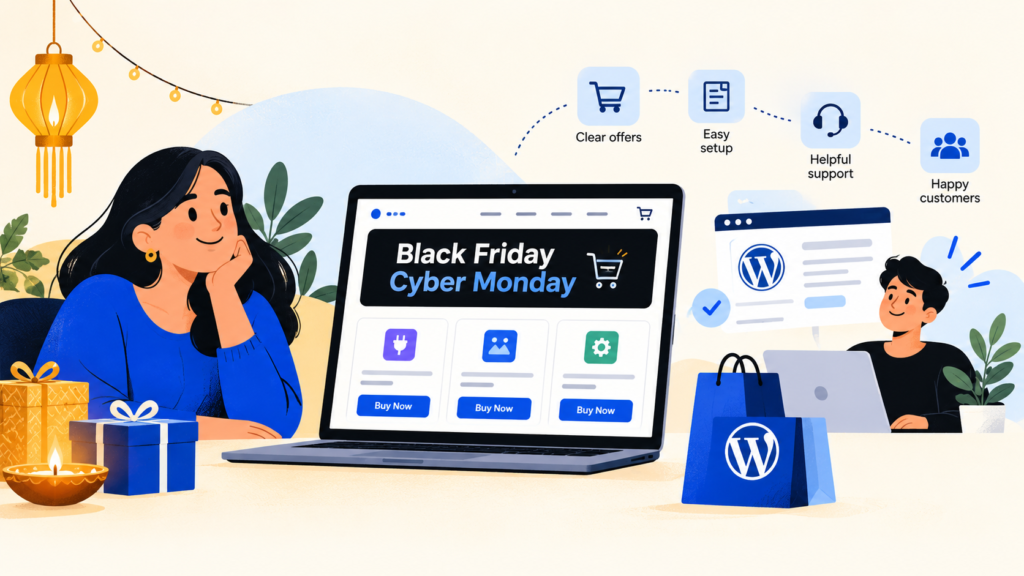
Every year, Diwali brings its share of festive shopping, special offers, and reasons to treat ourselves and the people around us. Businesses prepare their campaigns, customers compare deals, and there’s plenty competing for our attention.
A few weeks later, the WordPress ecosystem enters its own major sales season: Black Friday and Cyber Monday. Plugin developers, theme companies, and SaaS businesses roll out discounts, bundles, and limited-time offers to attract new customers and reconnect with existing ones.
For WordPress users, this can be a great opportunity to invest in tools they’ve been considering, upgrade an existing setup, or discover products that help them build better websites.
But with so many offers competing for attention, there’s an interesting question worth asking: when everyone has a deal, what makes a customer choose one business over another — and remember that business afterward?
Price might win the first sale. The experience surrounding that sale can influence what happens next.
The discount gets attention. What happens next matters.
Imagine you’re looking for a WordPress plugin to add a feature to your website. You find three options that appear to solve the same problem, and all three have attractive Black Friday offers.
One is slightly cheaper. Another offers a long list of features, some of which you may never use. The third explains its features clearly, shows which WordPress setups it supports, and makes it easy to understand which plan suits your needs.
Which one would you choose?
The answer will vary from person to person. Price matters, especially when you’re running a small business, managing client websites, or paying for several plugins and services.
But the decision isn’t always about finding the lowest price. You also want to know whether the plugin will work with your existing setup, whether it receives regular updates, and whether you’ll be able to get help when you need it.
A product page that answers these questions can make the buying decision easier. One that leaves you searching through documentation, comparing confusing plans, or guessing about compatibility can make even a generous discount feel less attractive.
A good offer makes the purchase attractive. A good experience helps make the decision feel right.
Black Friday is also a test of trust
Promotional campaigns create urgency by design. Offers have deadlines, prices change, and customers are encouraged to make a decision before the opportunity disappears.
That urgency can work. But it also makes clear communication especially important.
Consider a few questions a WordPress customer might have before purchasing:
- Does the discount apply only to the first year, or will the renewal price be the same?
- Does the bundle include all the products shown in the promotion?
- Are there limits on the number of websites covered by the licence?
- Will the plugin work with the customer’s current theme, page builder, or other essential plugins?
- What happens if the customer buys the wrong plan?
These details may not be as exciting as a big discount banner, but they can make a real difference to the buying experience.
A customer who understands the offer before purchasing is less likely to feel misled afterward. Clear pricing, transparent licence terms, and realistic product descriptions help customers make informed decisions.
And when expectations are clear from the beginning, the business has a much better foundation for a lasting relationship.
A great deal should feel like a great decision, not a surprise the customer discovers later.
The real test begins after checkout
For WordPress businesses, the customer journey doesn’t end when the payment succeeds.
A customer might purchase a plugin, install it, and then struggle to configure it. They might be unsure which setting to change, find that a feature behaves differently than expected, or run into a compatibility issue on a website with a complicated setup.
Sometimes the product works exactly as intended, but the customer needs help understanding how to use it. Other times, the instructions aren’t clear enough, or the onboarding experience assumes more technical knowledge than the customer has.
These are different problems, but each can affect how the customer perceives the product.
During a major sales period, many new customers can arrive within a short window. That can put pressure on documentation, onboarding, and support teams.
And this is where the experience can start to separate one business from another.
Imagine two different experiences.
In the first, a customer purchases a WordPress plugin, cannot get it working, searches through the documentation, and eventually submits a support ticket. The response points them back to the same article they already tried.
In the second, the customer finds a clear setup guide, gets a useful explanation of the relevant settings, and receives a support response that acknowledges the problem and explains what to do next.
Neither business can guarantee that every customer will have a perfectly smooth experience. WordPress websites vary considerably, and themes, plugins, hosting environments, and custom code can all affect how a product behaves.
But customers can tell the difference between being handed a response and being helped toward a resolution.
That difference matters even more when someone has just spent money and is trying to get value from the purchase.
When something goes wrong, communication counts
Customer delight doesn’t mean preventing every problem. That’s not realistic, especially when working with software.
Sometimes a plugin conflict appears after an update. Sometimes a bug needs further investigation. Sometimes the development team cannot provide a permanent fix immediately.
What happens in those moments can shape the customer’s perception of the business.
A useful support response doesn’t have to promise an instant fix. It should explain what’s known, acknowledge the impact on the customer’s website, and provide a realistic next step.
If the investigation will take time, say so. If a temporary workaround is available, explain it. If the issue needs to be escalated to the development team, make that clear and set an expectation for the next update.
And if the business makes a mistake, owning it is more valuable than trying to make the response sound perfect.
Customers don’t expect every plugin or theme to be flawless in every possible configuration. They do need to know that someone is taking their concern seriously.
This is one reason I see customer support as more than a function that closes tickets. It plays a significant role in building trust, particularly when the experience isn’t going according to plan.
I’ve written more about this in What Is Customer Delight? It’s More Than Just Good Customer Support.
The experience starts before the customer needs support
Support is important, but it shouldn’t be the only place WordPress businesses invest in the customer experience.
Some of the most frustrating customer problems can be prevented before a support ticket is ever created.
For plugin developers, theme companies, and other WordPress businesses, that might mean:
- Clear product pages: Explain what a plugin or theme does, who it is for, and what it doesn’t do. Avoid making customers guess whether a feature is included in a particular plan.
- Honest promotional terms: Make renewal pricing, licence limits, website limits, eligibility, and exclusions easy to understand.
- Useful onboarding: Give new customers a clear starting point, whether that’s an installation guide, a setup checklist, or a walkthrough of the most important features.
- Reliable documentation: Keep instructions accurate and update them when product interfaces, settings, or features change.
- A straightforward support experience: Make it easy to ask for help, share relevant troubleshooting information, and understand what happens after submitting a request.
None of these requires a flashy campaign. They require businesses to pay attention to the details that affect customers.
For example, a well-written setup guide might prevent dozens of customers from opening tickets about the same configuration issue. A clear explanation of licence limits might prevent frustration when a customer tries to use a plugin on additional websites. A timely announcement about a known compatibility issue might save someone hours of troubleshooting.
These improvements may happen behind the scenes, but customers feel their impact.
A customer who has a smooth experience during a promotion may be more comfortable recommending the product to someone else. A customer who feels confused or abandoned after purchasing may hesitate to renew, regardless of how attractive the original offer was.
Don’t let the sales target overshadow the customer
It’s understandable that businesses focus heavily on conversions during a major sales campaign. The work behind these promotions can involve months of preparation, and the results matter.
But there’s a difference between getting someone to buy a WordPress product and helping them succeed with it.
A large number of purchases might look like a successful campaign in the short term. What happens over the following weeks and months is worth watching too.
Are new customers installing and activating their purchases? Are they reaching the outcomes they expected? Are support requests revealing recurring confusion about a feature or setting? Are customers returning, renewing, or recommending the product?
These questions help businesses understand whether a promotion created lasting value or simply brought more people through checkout.
They can also reveal opportunities to improve the product itself. Repeated support questions may point to a missing explanation in the documentation. A pattern of setup difficulties might suggest that onboarding needs work. Feedback about unclear licence terms could indicate that the product page needs a better explanation.
The answer isn’t to stop running discounts. It’s to treat the sale as the beginning of the customer relationship rather than the finish line.
That shift can change how businesses plan their campaigns, prepare their support teams, improve their documentation, and measure success.
When the offers end, what will customers remember?
Ideally, customers will remember that they found a useful WordPress product at a good price. But they should also remember that the business made the experience straightforward, communicated honestly, and helped them get value from their purchase.
They might remember how easy the plugin was to set up, how clearly the documentation explained a feature, or how the support team handled an issue that initially seemed difficult to resolve.
Those things may not be as immediately visible as a 40% or 60% discount. They may not fit neatly into a promotional banner either.
But they are part of what makes a business worth returning to.
Black Friday and Cyber Monday create a concentrated period of buying decisions. For businesses in the WordPress ecosystem, that makes them an opportunity to attract new customers — and an opportunity to show those customers what the relationship will look like after the promotion ends.
The discount might be the reason someone buys from you. The experience is part of the reason they stay.
And perhaps that’s the question worth asking before launching the next big sale: once the countdown ends and the discount disappears, what will the customer remember about doing business with you?